The Golf Training Aids Beginners Actually Need
Golf is hard enough without filling your garage with training aids you never use.
For beginners, the best golf training aids are not the flashiest tools or the ones promising instant distance. They are the ones that help you understand what your body, club, and ball are supposed to do.
A good training aid should make practice simpler. It should give you feedback you can feel, see, or repeat. It should help you build a better habit instead of adding another thing to think about.
If you are new to golf, start with training aids that support the fundamentals: setup, alignment, swing path, tempo, contact, and putting.
What Makes a Golf Training Aid Good for Beginners?
A beginner-friendly training aid should do three things well.
First, it should provide clear feedback. You should know quickly whether you made the right move or the wrong move.
Second, it should be easy to use without a coach standing next to you. If the setup is confusing, you probably will not use it consistently.
Third, it should help you practice one skill at a time. Beginners often struggle because they try to fix everything at once. The right training aid narrows the focus.
For example, an alignment stick does not fix your whole golf swing. But it can help you aim better, set up more consistently, and start understanding how your feet, hips, shoulders, and target line relate to each other.
That is exactly what a beginner training aid should do.
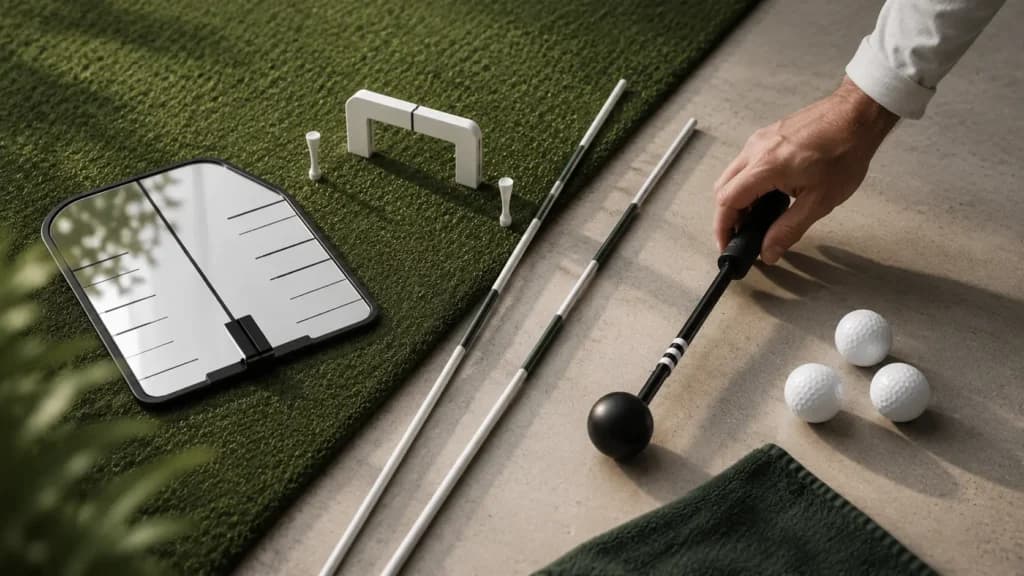
1. Alignment Sticks
Alignment sticks are one of the simplest and most useful golf training aids you can own.
Most beginner golfers aim their feet, shoulders, or clubface somewhere different from where they think they are aiming. That makes it much harder to evaluate the actual swing.
If you hit a bad shot while aimed incorrectly, you may blame your swing when the real issue was setup.
Alignment sticks help you build a reference line. Place one stick on the ground toward your target and another parallel to it for your feet. This gives you immediate visual feedback before you swing.
They can also be used for ball position, swing path drills, putting gates, and takeaway practice.
For a beginner, alignment sticks are a must-have because they make practice more structured without making it more complicated.
2. Putting Mirror
A putting mirror helps with one of the most overlooked parts of the game: setup on the green.
Many golfers miss putts before the stroke even begins. Their eyes are too far inside or outside the ball, their shoulders are open, or the putter face is not aimed where they think it is.
A putting mirror gives you a simple visual checkpoint.
You can see whether your eyes are over the ball, whether your shoulders are square, and whether your putter is starting on the intended line.
This is especially useful for beginners because putting does not require speed, strength, or athleticism. It rewards repeatability. A putting mirror helps you build that repeatability from the ground up.
3. Swing Tempo Trainer
Many beginner golfers swing too fast from the top.
That usually leads to poor contact, loss of balance, and inconsistent direction. A tempo trainer can help you feel a smoother sequence.
The goal is not to swing slowly forever. The goal is to learn rhythm.
A good tempo trainer encourages you to let the club load, transition, and release without forcing the motion. This can be especially helpful for golfers who feel like they are “hitting at” the ball instead of swinging through it.
Tempo tools are useful because they help you practice the motion of the swing without obsessing over the ball flight after every shot.
4. Impact Bag or Contact Trainer
Beginners often struggle to understand what solid contact feels like.
An impact bag or contact trainer helps you feel where the club should be at impact. The goal is to train your hands, body, and clubface to arrive in a stronger position.
This type of training aid can be useful because it slows the swing down and isolates the most important moment: impact.
You do not need to hit hundreds of balls to work on contact. Sometimes a few slow rehearsals into an impact bag can help you understand the difference between flipping the club and compressing the ball.
For beginners, this can be a helpful bridge between swing theory and physical feel.
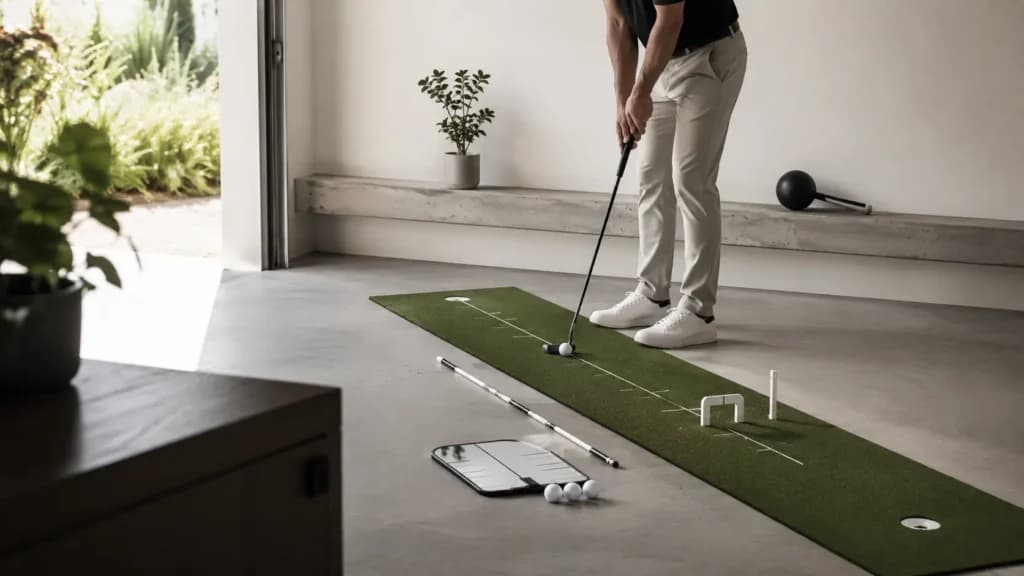
5. Putting Gates
Putting gates are simple tools that help you start the ball on line.
Most golfers spend time reading greens but do not know whether they are actually starting the putt where they intend. A putting gate gives you immediate feedback.
Set up a gate just wider than your putter head or a few inches in front of the ball. If the ball rolls through the gate, your start line was reasonably accurate. If it hits the gate, something in your face angle or stroke path needs attention.
Putting gates are excellent for beginners because they make practice measurable. You are no longer just rolling putts across the carpet. You are training a specific skill.
6. Chipping Net
A chipping net can be useful if you need a simple way to practice short-game contact at home.
The biggest benefit is convenience. If a training aid makes you practice more often, it has value.
That said, beginners should use chipping nets carefully. Do not only focus on whether the ball lands in the net. Focus on setup, clean contact, consistent trajectory, and landing spot control.
A chipping net works best when paired with a mat, a few landing targets, and a clear practice routine.
What Should Beginners Avoid?
Beginners should be careful with training aids that are too complex, too restrictive, or too focused on advanced swing mechanics.
If a tool forces your body into a position without helping you understand the movement, it may not be the best starting point.
You should also avoid buying five different tools for the same issue. More equipment does not automatically mean better practice.
Start with a few basics. Use them consistently. Then add more specific training aids once you know what part of your game needs the most help.
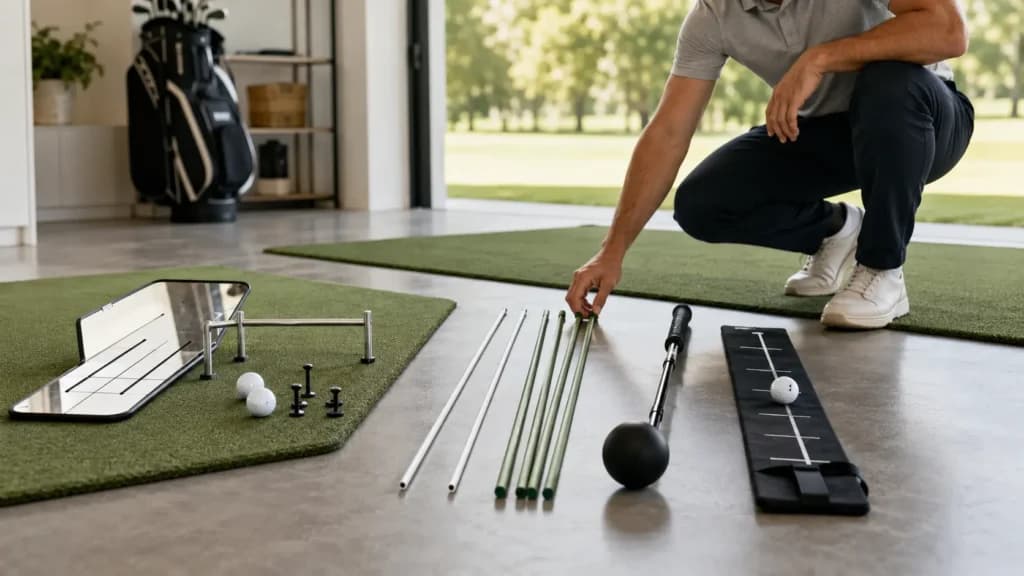
A Simple Beginner Training Aid Setup
If you are building your first practice kit, start with this:
- Alignment sticks
- Putting mirror
- Putting gate
- Tempo trainer
- Contact or impact trainer
That gives you coverage across setup, aim, putting, rhythm, and impact.
You do not need every golf gadget on the market. You need a few tools that help you practice with more intention.
Final Thoughts
The best golf training aids for beginners are the ones that make practice easier to understand.
They give you feedback. They help you repeat better movements. They turn vague swing advice into something you can actually feel or see.
Before buying a training aid, ask one simple question:
If you can answer that clearly, it is probably worth considering. If you cannot, it may be another golf gadget that ends up in the closet.