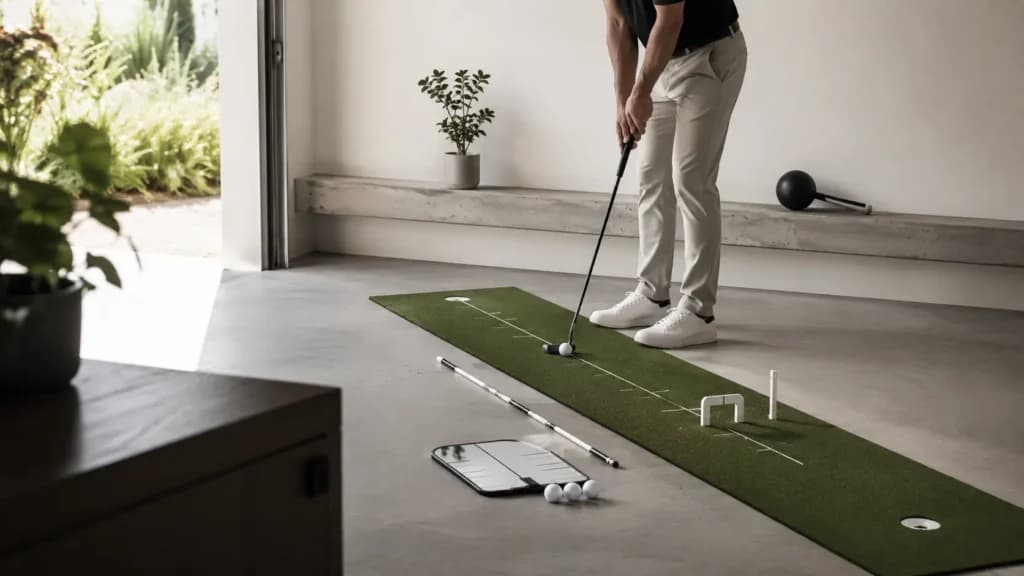
Drills
Published May 23, 2026How to Practice Golf at Home and Actually Get Better
Build better habits between rounds with focused drills for putting, alignment, tempo, impact, and chipping contact.
Indoor practice
Choose a safe, measurable practice task for your available space, then use feedback and repetition that can transfer back to the course or practice area.
Start with the constraint
Indoor practice is often treated as a substitute driving range, but many rooms cannot safely support full swings or ball flight. The better starting point is to identify what the space can support: putting, setup rehearsal, a short motion, or a no-ball routine.
The aim is not to collect indoor equipment. It is to create a visible task, repeat it with a consistent reset, and later test whether the routine still helps in a larger practice environment.
These are signs that the session needs a narrower task rather than more equipment.
A practical framework
Indoor practice works best when the session is designed around the space first. Then you can choose a visible signal, repeat a small task, and confirm that it still helps when you return to a normal practice setting.
Measure usable floor space and overhead clearance. Decide whether the session supports putting, short motion, or no-swing rehearsal before adding a drill.
Choose one signal you can see or record, such as a start line, setup position, contact point, or repeatable tempo cue.
Use short sets with a clear reset between repetitions. Quality comes from repeating the same task, not from filling time with unfocused motion.
Revisit the same checkpoint outdoors, on the range, or on a practice green. Indoor success matters only if the routine remains useful in the real setting.
Practice methods
A limited space can still support useful feedback when the task matches the room. Do not make a full swing unless the area and clearance are suitable.
Rehearse target selection, posture, ball position, or a pre-shot sequence without hitting a ball. Use a floor reference only where it cannot create a trip or impact hazard.
Roll putts toward a start-line gate or small target over a known distance. Separate starting direction from pace so each set has one clear purpose.
Use a count, metronome, or recorded routine for motion that fits the room. The cue organizes repetition; it does not prove that the motion is technically correct.
Tool categories
Category guidance can be useful before products are selected. Favor compact feedback that fits the task, stores easily, and can be positioned without relying on unverified product claims.
A small target, line, or gate can make starting direction visible during short putts. The available roll distance determines which task is realistic.
Floor markers can support ball position, stance width, and target-line rehearsal. Remove or secure them when they are not part of the session.
A timer, metronome, notebook, or camera can make repetition and routine observable without requiring a ball or full swing.
Build a complete routine
The home-practice pillar provides the full routine. The choosing and beginner guides help you decide whether a tool adds useful feedback or simply adds clutter.
Drills
Published May 23, 2026Build better habits between rounds with focused drills for putting, alignment, tempo, impact, and chipping contact.
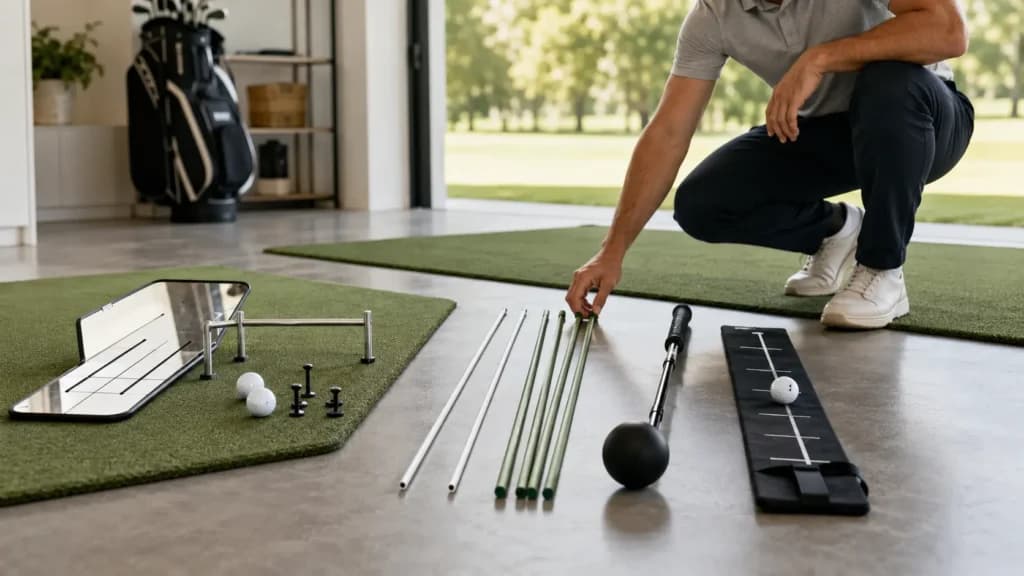
Guides
Published May 23, 2026Start with the issue in your game, then choose the training aid that gives you the clearest feedback for that issue.
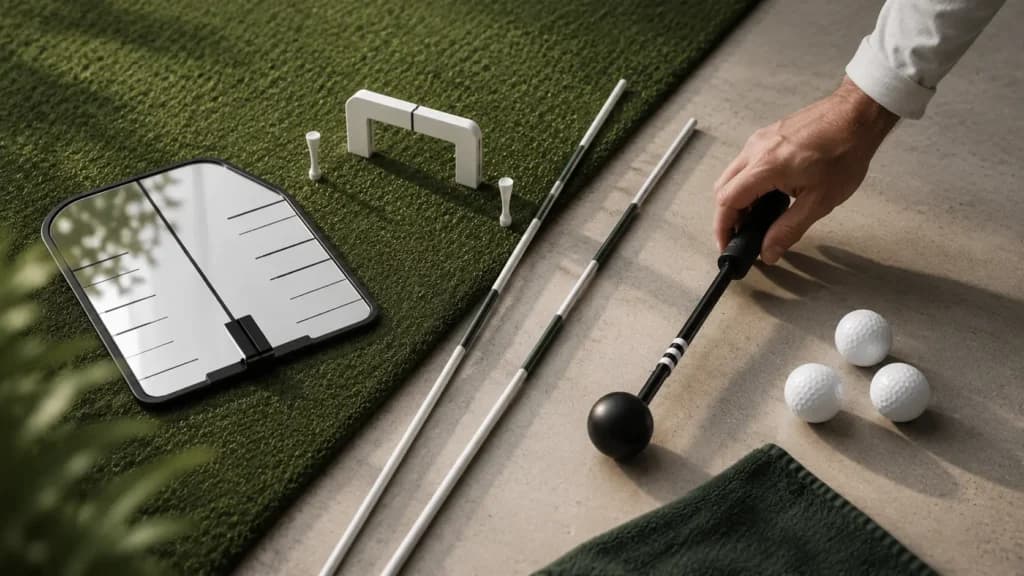
Guides
Published May 23, 2026The best beginner golf training aids make practice simpler by giving you feedback you can feel, see, or repeat.
Related goals
Indoor stations often begin with putting or alignment because both can use visible references in a small area.
Practice tips
Email signup is not active yet. Contact details and an email marketing provider are required before subscriptions can be collected.
© 2026 Darts Not Divots. All rights reserved.